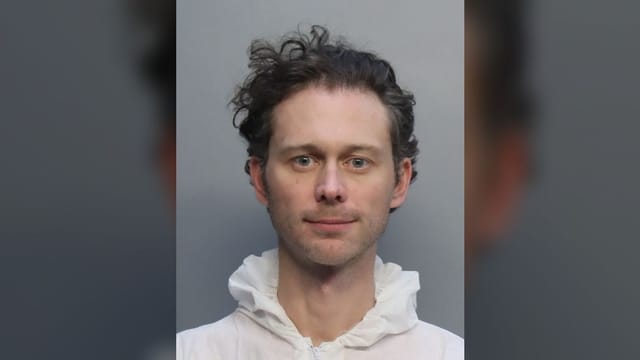
Miami-Dade prosecutors dropped kidnapping and aggravated-battery charges against former Ohio Republican legislative candidate Daniel Kalmbach after losing contact with the alleged victim for months, leaving them unable to prove their case when a judge refused to postpone his trial again.
In a November 16 internal memorandum obtained by TiffinOhio.net, Assistant State Attorney Janeen Zamora detailed an unsuccessful search for the woman that stretched from Miami to Pennsylvania. Prosecutors tried telephone calls, emails, subpoenas and assistance from law enforcement, but were unable to secure her participation in the trial.
The prosecution had no video footage of the alleged assault and no other witness who had observed it. When Circuit Judge Carmen Cabarga refused another postponement on November 9, prosecutors dropped both felony charges rather than proceed to trial without the woman.
“We could not prove the case at trial without the victim’s cooperation,” Zamora wrote.
The decision ended a nearly nine-month prosecution in which Kalmbach, 31, faced a possible life sentence. He had pleaded not guilty to both charges.
The records also reveal that prosecutors declined to pursue a separate domestic-violence case stemming from Kalmbach’s July arrest after the same woman twice told their office she did not want charges filed. That case was subsequently sealed, explaining why it disappeared from public court searches.
Prosecutors spent months searching for alleged victim
Zamora’s memorandum provides the first detailed account of why the case fell apart after months of preparation for trial.
When she took over the prosecution in July, Zamora discovered that previous efforts to contact the alleged victim had been unsuccessful. She called and emailed the telephone number and address prosecutors had previously used to communicate with the woman, but received no response. Support staff also failed to reach her to arrange a deposition.
Subpoenas sent to the woman’s last known Miami-area residence were returned unserved. Building employees told investigators she had moved out in June, leaving prosecutors without a confirmed address as the case approached trial.
In October, the State Attorney’s Office expanded its search. Investigators checked additional telephone numbers and addresses, sent more subpoenas and attempted to identify social media accounts that could help establish contact.
The search reached Pennsylvania, where prosecutors sought assistance from local police. Officers contacted the woman’s parents, who reported being estranged from her but provided a last-known telephone number. Calls to that number also failed to reach her.
Prosecutors eventually turned to their own investigative unit, which was unable to find her or identify another reliable means of contact.
By November 9, Kalmbach’s trial had already been rescheduled multiple times, and prosecutors still had no way to bring their central witness into court.
The only other listed witness had not seen the alleged assault, Zamora wrote. His involvement came afterward, when he helped Kalmbach and the woman contact police. Without the woman’s testimony, prosecutors had no other direct evidence they considered sufficient to prove the charges.
Prosecutors asked Cabarga to delay the trial again. The judge refused because this was the third scheduled trial date at which the state had been unable to establish contact with the woman.
The prosecution then dropped both charges. The court closed the case that day, released Kalmbach from the remaining conditions imposed in the felony proceeding and discharged his bonds.
Kalmbach had faced possible life sentence
The prosecution began with Kalmbach’s February 23 arrest in Miami following allegations of a violent encounter inside an apartment.
Police initially arrested him on allegations of false imprisonment and domestic battery by strangulation, both third-degree felonies. In April, prosecutors replaced those counts with more serious charges of kidnapping with a weapon and aggravated battery causing great bodily harm with a deadly weapon.
The formal charging document alleged that Kalmbach confined the woman against her will between February 21 and February 23 while using or threatening to use scissors or a knife. Prosecutors alleged that he cut her hair and cut her with a knife, causing injuries that left scars.
Under Florida law, the alleged use of a weapon elevated the kidnapping charge to an offense punishable by up to life in prison. The aggravated-battery charge was a first-degree felony.
Kalmbach pleaded not guilty and demanded a jury trial. Hearings and trial dates continued throughout the summer and fall.
Records separately obtained from the Miami-Dade Clerk show that Cabarga ordered Kalmbach taken into custody without bond during a September 10 hearing after finding probable cause that he had violated a stay-away order and committed another law violation. The available minutes do not establish how long he remained detained.
Less than two months later, the felony prosecution ended when the judge refused to grant prosecutors more time to locate the alleged victim. Kalmbach was never brought to trial on the kidnapping or aggravated-battery charges.
Political connections include Jim Jordan and Trump ambassador nominee
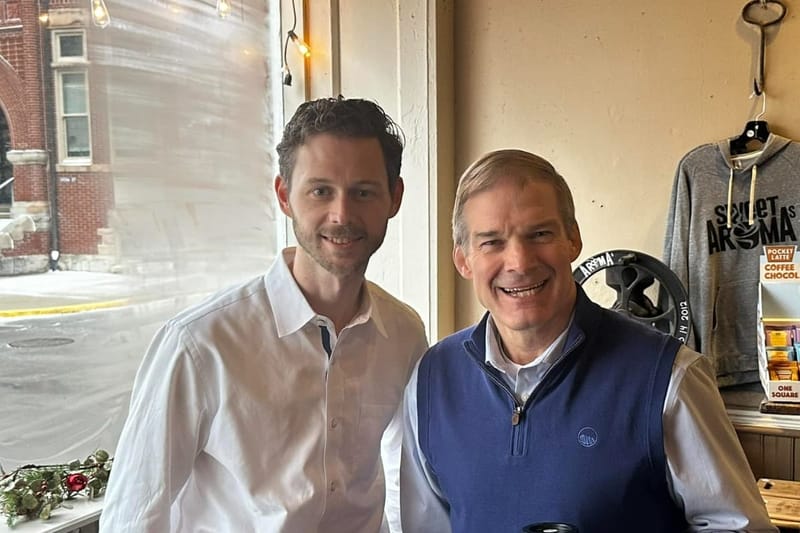
Kalmbach’s political connections extend to some of Ohio’s most prominent Republicans, including U.S. Rep. Jim Jordan, whom House Republicans elected November 10 as their incoming minority leader after losing control of the chamber in the midterm elections.
Jordan endorsed Kalmbach’s unsuccessful 2024 Republican primary campaign for Ohio House District 69, as did U.S. Rep. Bob Latta. Kalmbach also received backing from Americans for Prosperity and the Center for Christian Virtue in his challenge to incumbent state Rep. Kevin Miller, who defeated him in the March primary.
State Rep. Gary Click, a Vickery Republican, contributed $1,000 to Kalmbach’s campaign in February 2024, according to campaign finance records previously reviewed by TiffinOhio.net. Kalmbach later contributed $350 to Click’s campaign in May 2025.
Kalmbach is the son of Paul Kalmbach, chief executive of Kalmbach Feeds, the family-owned animal-nutrition company headquartered in Upper Sandusky. His father was nominated by President Donald Trump in June to serve as U.S. ambassador to Paraguay.
The Senate Foreign Relations Committee advanced Paul Kalmbach’s nomination November 18. It remains on the Senate’s executive calendar awaiting confirmation.
The elder Kalmbach has also been a substantial financial supporter of Republican candidates and organizations. Federal Election Commission records show he made a $250,000 contribution to the Trump 47 Committee, the joint fundraising organization supporting Trump’s 2024 campaign, on June 25, 2024.
A political contribution disclosure published in the Congressional Record during his ambassador nomination process lists additional donations, including $25,000 to Make Liberty Win in January 2024 and $5,000 to Latta’s congressional campaign in August 2026. The disclosure also details contributions involving the Republican National Committee, Bernie Moreno and other GOP political organizations. Some of those transactions reflect allocations from joint fundraising committees rather than separate contributions.
Kalmbach also appeared in a September episode of Lakefront Bargain Hunt Renovation, a former HGTV home-renovation series now airing on Magnolia Network. The program followed him and his partner as they renovated a waterfront home at Buckeye Lake.
TiffinOhio.net reported that the network began reviewing the episode after learning about the pending felony prosecution. The program had been filmed in 2025, before Kalmbach’s arrests.
Second domestic-violence case was dropped before charges were filed
The November 16 memorandum also establishes what happened to a separate criminal matter arising from Kalmbach’s July 14 arrest at the W South Beach hotel in Miami Beach, where police accused him of domestic-violence battery and violating a protective order involving the same woman.
As TiffinOhio.net previously reported, hotel employees told police they heard the woman screaming and crying. Officers reported observing redness on her face and forearm, and a records check showed that a domestic-violence protective order involving Kalmbach was already in effect.
Kalmbach denied that an argument or physical contact had occurred. The woman also told responding officers that no threats or harm had occurred, according to the arrest affidavit.
Although Kalmbach was arrested and initially appeared in misdemeanor court, prosecutors ultimately decided not to file formal charges.
On the day of his arrest, a prosecution paralegal contacted the woman, who said she did not want charges filed and declined to provide a statement, according to Zamora’s memorandum.
The woman later visited the misdemeanor prosecutor’s office without an appointment and repeated that she did not want the case to proceed.
Prosecutors decided not to pursue the July allegations around September 16. The misdemeanor case was sealed September 23, which explains why it no longer appears in ordinary public searches of Kalmbach’s criminal cases.
Those July conversations also marked the last documented direct contact between prosecutors and the woman, according to Zamora. The telephone number used to reach her was the same number felony prosecutors continued calling as they tried to prepare for trial.
The woman’s refusal to pursue the July case was documented separately from the February kidnapping allegations. Prosecutors did not report that she withdrew those earlier allegations. Their November memorandum instead describes repeated unsuccessful efforts to contact her.
TiffinOhio.net contacted Kalmbach’s defense attorneys, Howard Srebnick and Mark Shapiro, on November 11 seeking an explanation of the felony dismissal and an opportunity for Kalmbach to comment. Neither attorney responded by the November 12 deadline.
The State Attorney’s Office subsequently provided the case-closing memorandum, documenting prosecutors’ unsuccessful efforts to locate the woman and the judge’s refusal to postpone Kalmbach’s trial once more. The memorandum also confirms that the separate July case ended without formal charges after the woman twice told prosecutors she did not want it to proceed.